
Adopting AI to improve operations in certain ways is increasingly becoming a must for modern businesses to remain competitive in the market. What isn’t inevitable, however, is knowing where to begin. As soon as a business decides to bring AI into its tech stack, it typically arrives at the same fork in the road: should we prioritise a chatbot or an AI agent first?
The two terms are often used interchangeably in marketing copy and vendor pitches, but they solve different problems, cost different amounts to run, and suit different stages of business maturity. Understanding the distinction properly rather than relying on buzzwords is the difference between an AI investment that pays for itself within months and one that underdelivers. We break down exactly how chatbots and AI agents differ, where each one earns its keep, and what the costs and returns genuinely look like in 2026.
What’s the Difference Between an AI Chatbot and an AI Agent?
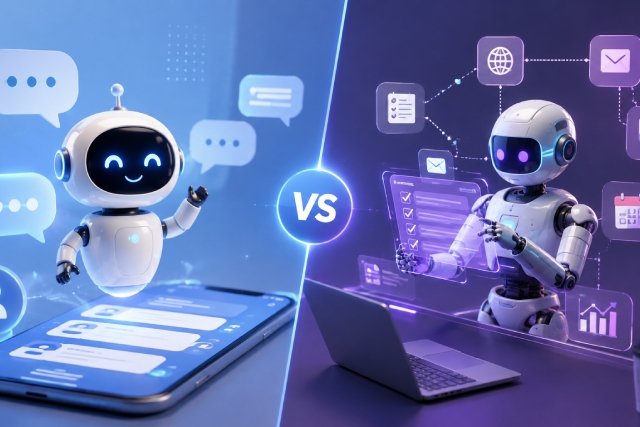
At its core, the difference comes down to one word: action. A chatbot is built to hold a conversation and respond to what a person types. An AI agent is built to pursue a goal by working through several steps on its own to get there. Put simply, a chatbot talks; an agent does.
This distinction plays out architecturally. A chatbot typically matches a user’s message to the closest pre-written answer or a relevant knowledge-base article, then stops. On the other hand, an AI agent runs on a continuous loop where it takes in information, decides on a next step, carries that step out using a connected tool or system, and checks whether the outcome actually solved the problem. If it hasn’t, the agent tries again or escalates.
It’s worth noting that this boundary isn’t always precise in practice. A basic chatbot that gains the ability to call an external system — say, to look up an order status — starts to take on agent-like qualities. Rather than two rigidly separate product categories, chatbots and agents sit on a spectrum of autonomy, and where a given tool falls on that spectrum matters more than what it’s labelled.
That labelling problem is worth flagging early, too. Analyst research has suggested that among the thousands of vendors currently marketing a product as an “AI agent,” only a small fraction meet a genuinely agentic architectural standard. Thus, this is a useful reminder for businesses evaluating vendors to look past the terminology and ask what the system can actually do.
How AI Chatbots and AI Agents Actually Work
Understanding how each system operates behind the scenes makes the practical differences much easier to spot. A chatbot’s logic is comparatively simple. Rule-based chatbots follow a fixed decision tree of scripted replies. More advanced AI chatbots use natural language processing and retrieval techniques to understand a wider range of phrasing and pull relevant answers from a knowledge base, but they still process one exchange at a time and don’t retain the ability to act beyond the conversation itself.
An AI agent works differently. It uses a large language model as a reasoning engine inside a loop that typically involves four stages: observing the request and any relevant context, reasoning about what needs to happen next, taking action through a connected tool or API, and evaluating whether that action achieved the goal. This loop can repeat multiple times within a single task, chaining together several actions like checking a database, updating a record, and sending a confirmation all without needing a human to manually trigger each step.
Interestingly, the underlying language model in a chatbot and an agent is often exactly the same. What separates the two is everything built around that model: the tools it can access, the memory it retains, and the guardrails that keep it operating safely within defined boundaries. This is a helpful way to reframe the decision: you’re not choosing between two different kinds of intelligence, but between two different levels of autonomy and system access.
When Should You Use an AI Chatbot?
Chatbots are a must-have and earn their place when the goal is simple, high-volume, and low-risk: answering common questions, guiding visitors to the right resource, and capturing basic information before a handover to a human.
They perform reliably for tasks such as responding instantly to frequently asked questions, surfacing the right knowledge-base content, routing enquiries to the correct team, and qualifying incoming leads before passing them to sales. For many businesses taking their first step into AI, a well-designed chatbot is the fastest way to demonstrate visible value without overengineering the rollout, requiring less integration work and proving ROI through measurable outcomes like ticket deflection and faster response times.
The limitations show up once requests move beyond a defined script. Ask a traditional chatbot to compare data across multiple systems, take an action on a customer’s behalf, or handle an unusual edge case, and it typically stalls, either offering an unhelpful generic response or escalating to a human anyway. This isn’t a flaw so much as a boundary since chatbots are read-only by design, and pushing them into execution-based tasks is usually where dissatisfaction creeps in.
When Should You Use an AI Agent?
AI agents become valuable the moment a task requires more than an answer and demands context, a decision, and follow-through across more than one system. Consider a customer asking about a delayed order. A chatbot can only explain the delivery policy in most cases, yet an agent can do more such as authenticate the customer, check the order and shipping systems, identify the cause of the delay, process a replacement if appropriate, and log the entire interaction in the CRM — all without human intervention. That same logic extends to sales and operations: qualifying a lead overnight, checking calendar availability, booking a meeting, and briefing the sales rep before their first coffee of the day.
It is important to understand that this power comes with proportionally higher responsibility. Where a chatbot’s mistake wastes a user’s time with a wrong answer, an agent’s mistake can trigger a wrong action—an incorrect refund, a duplicate booking, an unintended data change, and more. That asymmetry is why agent deployments demand stronger observability, testing, and approval controls than chatbots typically need, and why, for many small and medium-sized businesses, a fully autonomous agent can be more infrastructure than the problem actually requires. If the workflow doesn’t yet justify that complexity, a chatbot or a lightly tool-enabled version of one is often the smarter starting point.
Chatbot or AI Agent: Which One Fits Your Type of Business?
Company size matters less here than the shape of the workflow a business is trying to improve. Chatbots tend to suit start-ups, small businesses, and any organisation whose main challenge is handling a high volume of similar, well-defined queries without growing the support team. Retailers fielding repetitive product questions, service businesses managing bookings, or SaaS companies onboarding new users at scale are all strong candidates for a chatbot-first approach.
Agents come into their own once a business’s bottleneck is more operational rather than conversational. In other words, they are the better option when the real cost isn’t answering questions but coordinating action across CRMs, inventory systems, finance tools, or internal databases. Larger organisations with defined, API-connected workflows and a clear governance structure are typically best positioned to get value from agents quickly, though ambitious smaller businesses with one very specific, high-value workflow to automate can benefit just as much.
The healthiest way for businesses to frame this decision isn’t which is better, but which matches where we are. Many companies that start with a chatbot for customer-facing conversation later add an agent behind the scenes to handle the operational follow-through, and that layered approach tends to outperform either technology used in isolation.
How Much Do AI Chatbots and AI Agents Cost to Build and Maintain?
Cost is often the deciding factor in this conversation, so it’s worth being specific. A straightforward, FAQ-style chatbot in Singapore typically costs between $8,000 and $25,000 to build locally, while chatbots handling more complex, multi-step interactions tend to sit between $25,000 and $50,000. At the top end, chatbots built for regulated sectors such as banking or healthcare, where MAS compliance, legacy system integration, or PDPA-aligned data handling are non-negotiable, can climb to $100,000–150,000 or more. Smaller Singapore businesses should also note that many local chatbot projects qualify for government co-funding such as the Productivity Solutions Grant, which can meaningfully reduce the upfront outlay for SMEs.
AI agents cover a noticeably wider range, largely because “agent” can mean anything from a single automated workflow to a coordinated multi-agent system. A narrowly scoped agent handling something like lead qualification and CRM updates can start from the low tens of thousands of dollars, while enterprise-level agents built for complex decision-making, predictive analytics, or large-scale automation typically run from $60,000 upwards, with highly regulated or multi-system deployments extending well beyond that.
Build cost is only half the picture, though. Because an agent’s reasoning loop involves multiple planning steps, tool calls, and evaluations for every task it completes, it typically costs three to ten times more per resolved task than a chatbot handling an equivalent volume of interactions. Annual maintenance covering monitoring, retraining, security patches, and performance tuning commonly adds a further 15–30% of the original development cost every year, alongside ongoing cloud hosting and API fees. Chatbots carry a lighter version of this overhead, but agents demand it consistently given the higher stakes of letting a system take real-world action. None of this makes agents a poor investment; it simply means the upkeep needs to be budgeted for in dollars and realistic annual terms, not treated as an afterthought once the system is live.
Chatbots vs AI Agents: Which Delivers Better ROI?
Cost only tells half the story since the real question is what each pound spent actually returns.
Chatbots tend to offer a fast, easily measurable ROI. Industry benchmarks put the cost of a chatbot-handled interaction at roughly $0.70, compared with around $8 for the same interaction handled by a human agent. This is a substantial advantage at scale, particularly for high-volume, repetitive queries. Some enterprise deployments have reported chatbot systems handling workloads equivalent to hundreds of additional support staff, translating into significant profit improvements.
Agents can deliver an even sharper cost advantage per resolved task once matched to the right problem, with some benchmarks suggesting a roughly ninefold reduction in cost per resolution compared with human handling, with modern agents now resolving the majority of first-contact queries end-to-end. The catch is that this return only materialises when the agent replaces genuine human effort—a decision, a cross-system lookup, an action—instead of simply replacing something a chatbot could already do more cheaply. Deploying agent-level infrastructure to solve a chatbot-level problem is one of the most common ways businesses erode their own ROI.
The takeaway is straightforward: ROI isn’t a property of the technology itself, but of how precisely it’s matched to the task.
Should You Start With a Chatbot or an AI Agent First?
This is the question most businesses are really asking, and the honest answer is that it depends less on which technology is more advanced and more on which stage of automation maturity your business is currently at.
Most organisations that adopt AI successfully tend to follow a similar progression wherein they start with a chatbot to reduce conversational volume, gradually connect it to internal tools for simple lookups, evolve towards agentic workflows that can execute tasks, and eventually coordinate multiple agents across departments. Viewed this way, chatbot or agent first becomes less of a binary decision and more a matter of honestly assessing how mature your current workflows and systems already are.
If your business doesn’t yet have a clearly scoped, high-value process to automate, a chatbot is almost always the more sensible starting point—it’s faster to launch, easier to govern, and gives you a working proof of concept to build from. If you already have a well-defined workflow with connected systems and a clear owner, introducing an agent for that specific task can deliver strong returns from day one.
Making the Right Call for Your Business
There’s no universally correct answer to the chatbot-versus-agent debate, because the right answer depends entirely on your business’s current workflows, systems, and goals. What matters is choosing deliberately rather than defaulting to whichever term sounds more impressive in a sales pitch.
For many businesses, the most effective long-term setup isn’t chatbot or agent—it’s chatbot and agent, each handling the part of the job it’s genuinely built for: the chatbot managing the conversation, the agent managing what happens next. Getting that combination right, and sequencing it sensibly, is where the real value lies.
If you’re weighing up where to start, our team can help you map your workflows, identify the highest-impact starting point, and build a solution that fits your business rather than a generic template. Talk to our team today and take the first step for your business.
Frequently Asked Questions
1. Is an AI agent just a more advanced chatbot?
Not exactly. While both can rely on the same underlying language model, an AI agent is built with additional capabilities — memory, tool access, and a reasoning loop — that allow it to plan and carry out multi-step tasks. A chatbot is designed to converse; an agent is designed to complete work.
2. Can a chatbot be upgraded into an AI agent later on?
In many cases, yes. Because the two sit on a spectrum rather than being entirely separate systems, a chatbot that’s given access to tools and APIs can gradually take on agent-like behaviours. This is a common and sensible upgrade path for businesses that aren’t ready for a full agent deployment from the outset.
3. Do AI agents replace human employees?
Generally, no — they’re best used to take over repetitive, multi-step administrative work so that employees can focus on judgement-based or relationship-driven tasks. Most successful deployments position agents as a support layer for staff rather than a direct replacement.
4. Which is cheaper to run long-term, a chatbot or an AI agent?
Chatbots are almost always cheaper to run on a per-interaction basis, since agents require more computing resources for each task due to their multi-step reasoning process. However, agents can still deliver a stronger return when they’re replacing genuine manual work rather than a simple query.
5. How do I know if my business is ready for an AI agent?
A useful test is whether your workflows are clearly defined, your systems are connected via APIs, and you have the governance in place to set appropriate boundaries and approvals. If those conditions aren’t met yet, a chatbot is usually the more practical starting point.
6. Can chatbots and AI agents work together?
Yes, and for many businesses this combination delivers the best results. A common setup uses the chatbot as the first point of contact for simple, high-volume queries, with more complex requests handed off to an AI agent capable of taking action across connected systems.